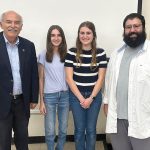
Left to right: Prof. Barlow Der Mugrdechian, Emily Sahakian, Jordan Mazmanian, and director Ashot Poghosyan. Photo: ASP Archive
Emily Sahakian
Staff Writer
For centuries, the Syunik province has stood as one of Armenia’s most strategically and culturally significant regions, carrying a history deeply connected to the Armenian people’s identity, faith, and survival. On Friday, September 18, the Armenian Studies Program hosted a screening of the documentary “Syunik: The Last Border,” directed by Ashot Poghosyan and produced by Dr. Sargis Mesrobian, drawing a strong turnout from the local Armenian community. From ancient monasteries and archaeological sites to its modern borders and geo-political significance, Syunik is presented in the documentary as a region where Armenia’s past, present, and future are closely connected.
The event began with introductory remarks from Armenian Studies Program Coordinator Prof. Barlow Der Mugrdechian and director Ashot Poghosyan.
The documentary explores Syunik’s deep historical roots while examining the challenges the region faces today. Following the loss of Artsakh in 2023, the film presents Syunik as another region whose security and preservation have become increasingly important for Armenians.
The film opened by tracing the history of Christianity in Armenia and the role faith has played in Armenian identity. Syunik is described as “an ancient cradle of Christianity.” Armenia became the first nation to officially adopt Christianity as its state religion, and the film portrays this history as central to understanding the struggles Armenians have faced for centuries.
According to the film, Armenia’s Christian identity has repeatedly placed it at the center of conflicts with surrounding nations. Syunik is presented as more than just its territorial significance. Protecting Syunik means preserving a place where Armenian history, culture, and faith have endured for generations.
Through stunning aerial cinematography and historical narration, the film takes viewers through the historic monasteries of Tatev and Vahanavank, the ancient stone formations of Karahunj, the cliff-carved cave village of Khndzoresk, the petroglyphs of Ukhtasar, the southern border city of Meghri, pristine lakes, and the Arax River. The film also journeys through the towns of Goris, Kajaran, and Kapan, the provincial capital of Syunik. Poghosyan, who joined the Fresno State screening, spoke of the beauty of Syunik and said, “Ancient Armenian culture lives in Syunik. Its churches, monasteries, graves, and khatchkars [cross-stones] carry a history we share with the world.”
But beneath the beauty of Syunik is a complicated history.
During the early 20th century, the Syunik region widely became known as Zangezur. Following the establishment of the First Republic of Armenia in 1918, territorial disputes emerged among the newly independent republics of Armenia, Azerbaijan, and Georgia. Zangezur became one of the contested regions between Armenia and Azerbaijan. In the subsequent Soviet period, Zangezur remained part of Soviet Armenia while Karabakh and Nakhichevan were placed under Soviet Azerbaijan. This history is relevant to the film because the Syunik province is Armenia’s southernmost connection to Iran, making it strategically significant for the country’s transportation, trade, and regional connections. The road connecting Armenia and Iran runs through Syunik, further elevating Syunik’s importance and its need for protection. The documentary turns particular attention to Meghri, a city located at the southernmost edge of the Syunik province along the border of Iran. Because of its location, Meghri stands as the epicenter of enormous challenges and has become central to discussions about regional transportation and security. The film portrays Meghri as a city that has continued to endure despite threats and is considered to be the greatest guarantee of our vitality, serving as a symbol of Armenia’s strength despite the many challenges it has faced.
Amidst the creation and release of this film, discussions surrounding the proposed transportation route connecting Azerbaijan with Nakhichevan through Armenian territory continue to take root, reflecting longstanding disputes over the region. Syunik’s geographic location has placed the province at the center of ongoing regional discussions. More recently, in August 2025, Armenia, Azerbaijan, and the United States signed a joint declaration to end decades of conflict, called the TRIPP (Trump Route for International Peace and Prosperity) Agreement, which is a proposed transportation and infrastructure network that would run through the southern part of Armenia, linking Azerbaijan with the Nakhichevan exclave. This development has added to the growing attention around Syunik and its future.
Against this backdrop, the documentary first draws attention to what makes Syunik significant beyond its strategic location. The film shows a region filled with churches, monasteries, ancient settlements, and other reminders of Armenian history. At the same time, it presents Syunik as a strategically important part of Armenia whose future is tied to political and transportation decisions. By showing what exists in the region before discussing the challenges it faces today, the film asks viewers to consider why Syunik is worth preserving.
For the filmmakers, the discussion of Syunik cannot be separated from the loss of Artsakh. The Artsakh flag appears as a symbol of what has already been lost and as a reminder of the consequences of failing to protect Armenian territory and heritage. Poghosyan expressed his view that after the events in Artsakh, it is difficult to talk about Syunik without fear, especially amidst the ongoing political debate surrounding the region. “What happened in Artsakh was a genocide and the world did not respond as it should have,” said Poghosyan.
The film’s message is direct: Armenians cannot rely on outside powers to preserve their homeland. Without learning from the past, the documentary warns, Armenians risk finding themselves on the same painful pages of history again.
The documentary calls for Armenians to recognize the importance of Syunik and to remain vigilant about its future, as it is one of Armenia’s last remaining strongholds. “We must do all we can to spare Syunik the same fate,” proclaimed Poghosyan.
The film’s producer, Dr. Sargis Mesrobian, echoed Poghosyan’s remarks after the screening. “As Armenians, we have to do everything in our power to convey the faith of our forefathers and the virtues of our Christian heritage to our posterity,” said Mesrobian.
Throughout the film, Syunik emerges as much more than a geographic region. Its monasteries represent faith, its caves and fortresses represent generations of survival, and its lakes and mountains represent the natural heritage of the land. By moving between Syunik’s ancient history and its contemporary challenges, the documentary invites viewers to consider why the region holds such significance for Armenians today. “Syunik: The Last Border” provides a window into a province whose history extends far beyond the current political debate.