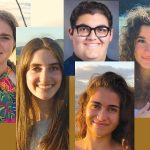
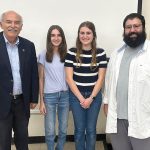
“Shushi Portraits, 2021.” This work depicts portraits of former residents of Shushi, photographed in 2021, now displaced and refugees, standing amidst ancient Armenian illuminated manuscripts. Photo: Barlow Der Mugrdechian
Karly Arslanian
Staff Writer
Walking through Ara Oshagan’s photographic exhibition, “Ara Oshagan: Armenian Diasporic Trajectories-Los Angeles, Beirut, Artsakh, Fresno,” at the Fresno State Library feels less like looking at a traditional photography exhibit and more like moving through small pieces of a much larger story. Photographs, collages, portraits, and historical images all come together to explore what happens when people, families, and communities are separated from the places they call home. Spanning from Los Angeles, Beirut, and Artsakh to Fresno, the exhibition connects different moments and places through the experiences of the Armenian diaspora.
What makes the exhibit notably interesting is the way Oshagan combines documented photography with his own imagination. Rather than just presenting history as something fixed in the past, his work shows how it continues to exist in the present through memories, family, displacement, and identity. All to say, his work captures the moments of an unfolding story.
One of the earliest pieces of work presented, “That You May Return, 2023,” documents the Armenian community in Los Angeles between 2000 and 2010. The photographs focus on everyday life, showing Armenians not simply as a historical group, but as people actively creating a culture here in the present. The project focuses on preserving the everyday, documenting routine moments that usually go unnoticed or forgotten. The work also presents the Armenian community as existing within two spaces at once: maintaining its own distinct identity, while also being part of the larger Los Angeles community.
That idea of identity across different places becomes a bit more personal in “Beirut Memory Project, 2018-2021.” Oshagan grew up in Beirut within an Armenian diasporic community shaped by the aftermath of the Genocide. When the Lebanese Civil War forced his family to leave, his connection to the city became tangled with displacement. But decades later, Oshagan returned to photograph the neighborhoods and spaces connected to his past. As a result, these images function on two levels, offering a record of physical places while also reflecting personal memories.
In “Beirut Memory Project” present-day black-and-white photographs of Beirut are layered with older photographs showing family, community, and the effects of war. By combining the images, Oshagan brings different periods of Beirut’s history into the same realm. The photographs show how his memories of the city are connected to both his personal experiences and the larger history of the Armenian community.
The exhibition then moves toward the future with works including “Shushi Portraits, 2021” where photographs from Artsakh are cut apart and reconstructed into new comprehensive scenes. The backgrounds come from the notebooks of Oshagan’s grandfather, writer Hagop Oshagan, who was also removed from his homeland during the Genocide. The work connects two generations of displacement while imagining what a future for the Armenian community could look like.
“Shushi Portraits” connects the experiences of displaced Armenians with a much older history. The series features former residents of Shushi who were displaced from their homes and photographs them in front of Armenian illuminated manuscripts that date back centuries.

“That You May Return, 2023.” Hmayils are medieval hand scrolls with protective powers. Photo: Barlow Der Mugrdechian
Placing these modern portraits alongside the manuscripts creates a connection between the people pictured and the history of the culture they come from, demonstrating how history remains relevant even when people are separated from their homes.
Personally, one of the most visually and conceptually interesting ideas in the exhibition appears in “That You May Return, 2023,” where Oshagan recreates medieval Armenian Hmayil scrolls, preserving their Classical Armenian text, while replacing their original illustrations with photographs from his own travels.
Historically, these scrolls were carried for protection and safe return. But by inserting photographs of what we consider “diasporic movement” into them, Oshagan transforms an ancient object into something connected to the experiences of Armenians across the world today.
The newest addition to the exhibition is “Valley of Origins, 2026” which focuses on the Armenian community of California’s Central Valley. For students, this work brings the exhibition especially close to our home.
The project looks at Armenian families who settled in the Central Valley beginning in the late nineteenth and early twentieth centuries. Using photographs, family histories, and historical objects, one can explore how those communities developed.
Ultimately, “Armenian Diasporic Trajectories” is about much more than just borders on a map. Oshagan presents borders as physical, cultural, historical, and personal.
His work shows how displacement can separate people from a place without necessarily separating them from their history. By bringing together photographs of everyday life, memories of war, historical materials and imagined futures, the exhibition creates this new conversation between generations. It asks us as viewers to consider not only where people come from, but how they carry those places with them wherever they go.