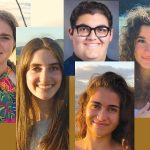
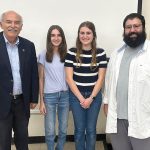
Left to right: Gerald Chooljian, Kenneth Bedrosian, Dr. Sergio La Porta, Ara Oshagan, Dr. David Zakarian, Margaret Shirin,
Daniel Shabazian, Dr. Hagop Ohanessian, and Prof. Barlow Der Mugrdechian at the opening reception of the exhibition. Photo: Issac Garcia Diaz
Karly Arslanian
Staff Writer
The opening reception for Ara Oshagan’s Fresno State exhibition “Ara Oshagan: Armenian Diasporic Trajectories – Los Angeles, Beirut, Artsakh, Fresno,” gave attendees an introduction to the ideas behind his work and the Armenian communities he has photographed across different places and generations.
The reception was held on Sunday, September 13, in the Leon S. Peters Ellipse Galley of the University Library.
Oshagan discussed the genesis of the exhibition, organized jointly with Prof. Barlow Der Mugrdechian of the Fresno State Armenian Studies Program. The reception also marked the first event in a year-long series celebrating the Armenian Studies Program’s 50th anniversary, bringing together students, faculty, and members of the local Armenian community.
The exhibition, which was open between September 1 through September 30, 2026, was sponsored by the Leon S. Peters Foundation, the Thomas A. Kooyumjian Family Foundation, the Ralph Shabazian Armenian Memorial Fund, and the Florence Elaine Hamparson Memorial Fund.
Oshagan described his work as an exploration of what he calls “diasporic presence.” Born in Beirut and displaced by the Lebanese Civil War, Oshagan explained that his own family history has influenced the way he approaches photography. His work looks at Armenian communities across different locations while also connecting their histories through photography, archives, and other forms.
Oshagan explained that his work is partly about making Armenian communities visible and documenting their presence in places where their histories might otherwise be overlooked. “There’s this attempt to erase us, so to speak, and I’m trying to make us visible,” said Oshagan. This idea of visibility connects many of the projects in the exhibition, which documents Armenian communities, while also exploring their histories of displacement and continuity.
A major theme throughout the exhibition was a connection between different places and periods of time. Oshagan described these connections as “trajectories,” explaining that they can be physical, emotional, and psychological. The exhibition moves between Los Angeles, Beirut, Artsakh and Fresno, while also bringing together photographs, archival material, manuscripts, and images of what he sees as an imagined future. He described the different elements of his work as being “entangled” through time, place, and form.
The Fresno portion of the exhibition focuses on Armenian families who have lived in the Central Valley for generations. Oshagan said many of the families he photographed have been in the area for four, five or even six generations, with many having connections to farming and the land. He explained that this relationship to land is different from what he sees in Armenian communities in places such as Los Angeles, making Fresno an important part of his exploration of the Armenian diaspora.

Fresno State President Dr. Saúl Jiménez-Sandoval, left, with curator and artist Ara Oshagan. Photo:Barlow Der Mugrdechian
Oshagan later gave an in-depth interview giving a better understanding of the personal ideas and experiences behind his photographs. One of the first things that stood out was how much he values the audience’s own interpretation of his work. “I meet the audience halfway,” Oshagan said. “An audience has to come the other half.” He explained that just as he brings his own history and experiences into his artwork, viewers bring their own experiences when they look at it. For Oshagan, a successful photograph is one that allows someone to connect with it personally.
But his approach to photography also requires much more time than simply taking a picture and moving on. Oshagan compared his photography to “a conversation and a novel,” explaining that his projects can take several years because he returns to places, meets people, learns their histories and develops a deeper relationship with his subjects.
Family has also influenced this approach. Oshagan spoke about his father, writer and poet Vahe Oshagan, who challenged traditional rules in Armenian literature. That willingness to think differently influenced Ara’s own approach to photography. “In terms of thinking out of the box and breaking rules in terms of image making rules, I think I get a lot of that from him,” Oshagan said.
His mother also has a connection to Fresno, having lived in the area while Oshagan visited her here, giving him a personal connection to the Central Valley beyond his artistic interest in the community.
That personal connection is one reason the Fresno project is especially meaningful to Oshagan. He said the current photographs are only the beginning and that he hopes to return to Fresno for longer periods of time to photograph more members of the community. He is also using “image-making technology” based on techniques from the late 1800s and early 1900s, connecting the photographs to the period when many Armenian families first settled in the Central Valley.
After spending time with Oshagan and hearing more about his thinking behind the exhibition, the Fresno photos take on a different perspective. What first stood out to me as larger-than-life photographs of local Armenian families became part of a much larger conversation about family, history, displacement, and the places people continue to call home.
Leaving the interview, one understood that for Oshagan, these photographs are not only about preserving the past, but also about making space for the stories that are still being written.