 Hye Sharzhoom Armenian Action
Katherine Arslanian
Staff Writer
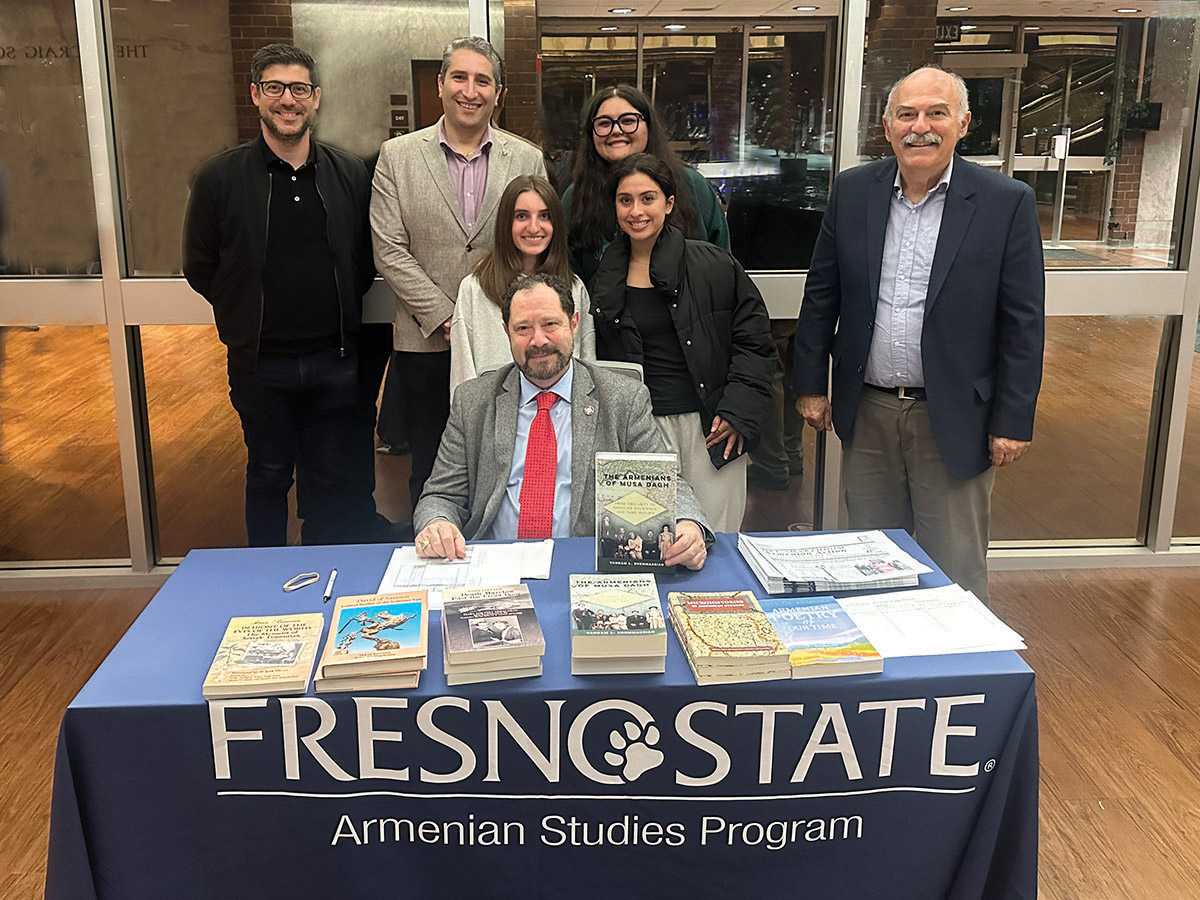
On Friday, November 14, 2025, the Armenian Studies Pro-gram, hosted a lecture by Kevork Oflazian, a Fresno State graduate, entitled “Homeland vs. Home: When a Call to Return to the Homeland is Not Answered.” The lecture examined the experiences of the Musa Dagh Armenians in Anjar, Lebanon, during the repatriation period of 1946–1948, exploring why some diaspora Armenians returned to Soviet Armenia while others did not. The lecture was supported by the Ralph Shabazian Armenian Memorial Fund.
Oflazian’s presentation provided a microhistory of a single community, drawing on oral interviews with townspeople, published and unpublished memoirs, contemporary newspaper articles, and secondary sources, including scholarly articles and dissertations. Oflazian opened with a moment of humor, “Before you criticize someone, you should walk a mile in their shoes. That way, when you criticize them, you are a mile away and have their shoes,” before diving into the story of a people shaped by exile, survival, and shifting notions of homeland.
The lecture traced the community’s origins to six villages on Musa Dagh (Mount Moses) in Eastern Turkey, where residents famously resisted Ottoman deportation for 53 days in 1915.
“So from these villages, they went up to the higher verges of this mountain, which was protected on one side by the Mediterranean Sea,” said Oflazian. “After about 53 days, they were running low on food and ammunition. So they made a large red cross, made with bed sheets.” French naval forces eventually evacuated the villagers to Port Said, Egypt, where they lived in refugee camps. After the war, most returned to Musa Dagh, planting orchards and rebuilding their communities. However, in 1939, the Sanjak of Alexandretta was ceded to Turkey, prompting yet another involuntary relocation. The French authorities resettled the Musa Dagh Armenians in what became the town of Anjar, Lebanon.
Oflazian described early Anjar as “a town with no water, electricity, or roads,” where res-idents relied on agriculture and largely had to fend for themselves.
Following World War II, the Soviet Union, under Joseph Stalin, and with the support of the Armenian Soviet Socialist Republic, launched a repatriation campaign, inviting diaspora Armenians to “return home.” The campaign was supported by the Catholicos of All Armenians in Etchmiadzin, but each entity had different motivations.
“The motivation to extend the invitation to the Armenian diaspora was partially, if not wholly, driven by the Soviet Union’s rivalry with the West,” Oflazian noted. Early excitement greeted the repatriation call. One story was about George, a 14-year-old in Beirut, watching his cousins depart for Armenia. “He would have loved to go with them,” Oflazian said, but his father refused, forcing George to borrow money from a family friend to return to Anjar.
Despite the initial enthusiasm, half of Anjar’s population declined to repatriate. Oflazian identified several key factors: ideology and political affiliation, and concepts of homeland.
Financial and material concerns, community and family ties, coded warning and propaganda were also part of the decision-making.
Many were affiliated with the anti-Communist wing of the Armenian Revolutionary Federation (ARF). Hovaness Amoghlian, recalling the discussions in 1946 of whether to go, or not to go, said his father often remarked, “Only Communists, Protestants, and the poor go to Armenia.” Families were sometimes asked to resign from the ARF in order to repatriate, which many refused. Some villagers did not view Soviet Armenia as their true homeland. One recounted her mother stating, “Here we are living under the Lebanese flag. If we go, we will still not be under the Armenian flag.” The Soviet flag, for them, symbolized foreign rule, not national return.
Financial hardship and the high cost of relocation discouraged many families from repatriating, as did the desire to remain together, even when some individual members wished to go, families prioritized staying together with siblings and ex-tended relatives.
Propaganda promising prosperity, “Armenia is a paradise,” was often met with skepticism, particularly as re-ports from prior repatriates revealed harsh living conditions, hunger, and struggle. Some of these warnings were even coded in letters, further discouraging departures and influencing families’ decisions to remain in Anjar.
Oflazian also discussed how missionary organizations and committees tried to persuade villagers to repatriate, but anti-Communist sentiment, loyalty to local communities, and practical concerns often outweighed these efforts.
Carol Bertram, cited in his research, noted, “Yet an effective loyalty to the Republic of Armenia does not replace the pilgrim’s sense of rootedness in the Western Armenia of Ottoman lands, with its distinctive history and culture that differs significantly from those of Eastern Armenia.”
A more conceptual issue also emerged, the idea of what “homeland” meant. The Musa Dagh Armenians were from historic Armenian lands in Turkey, not from the territory of the Armenian SSR.
“Some villagers did not see this movement as repatriation, but rather yet another migration to an imagined homeland that they were not originally from,” explained Oflazian.
On a map, he pointed out, “Armenia is way up there. Musa Dagh is way down here.”
For people who had already endured multiple forced migrations, the promise of a new homeland, this time under Communist rule, was not universally convincing.
By 1948, repatriation efforts ended abruptly, leaving Anjar as the permanent home for those who had chosen not to leave. “After the repatriation ended in 1948, Anjar remained the home for those that did not repatriate,” said Oflazian. “After more than 75 years, they remain Armenians, living in Lebanon, calling it their home. Although they maintain a strong connection to the current post-Soviet independent Republic of Armenia, they are strong nationalists and patriots; very few consider moving there now.”
He concluded with a broader reflection: “Finally, an overarching question is this: At what point does a land become a homeland? What does a nation mean for the multitudes that have in the past and continue to immigrate by choice or force? These questions become more relevant in the increasingly multicultural world of today.”
Oflazian’s lecture offered a nuanced exploration of identity, nationalism, and the complex meanings of “home” for a people shaped by exile and resilience.