 Hye Sharzhoom Armenian Action
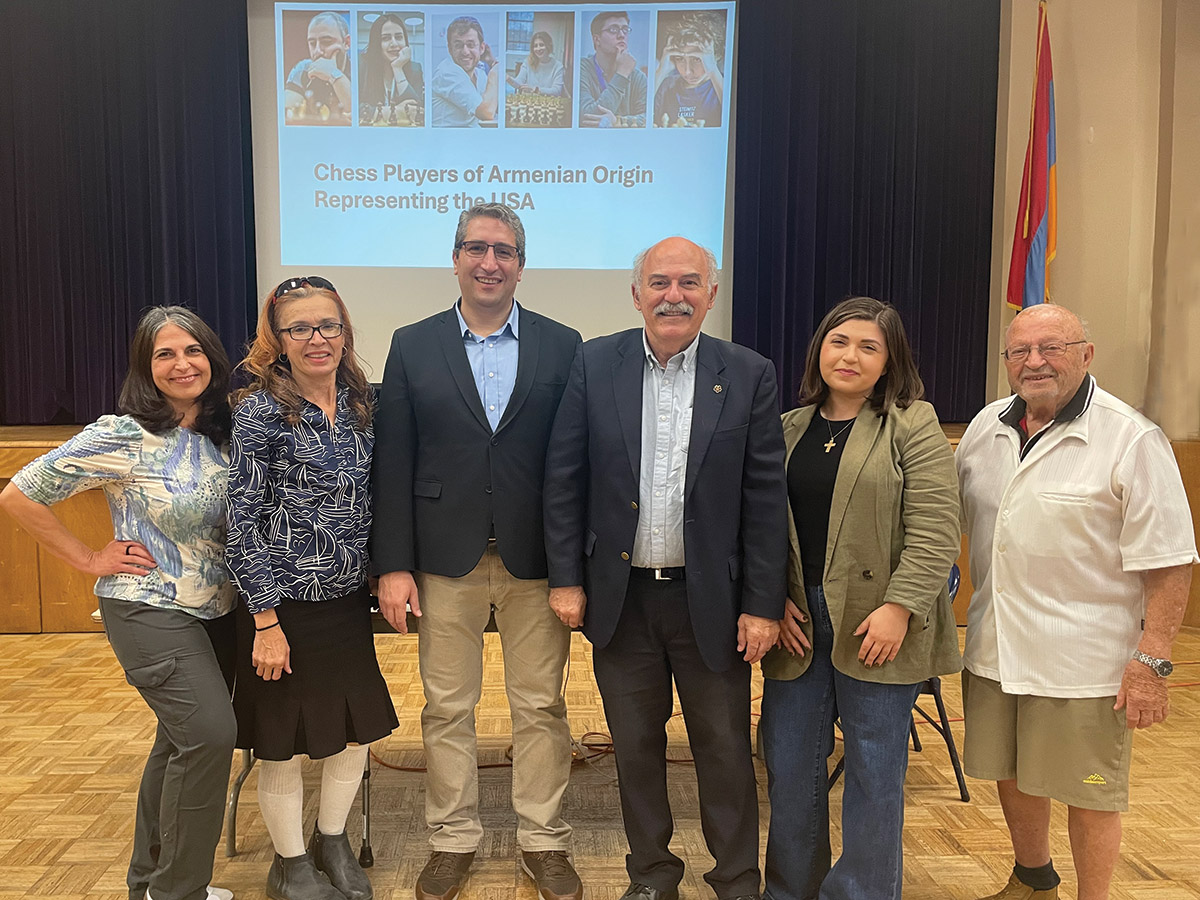
Left to right: Linda Shekerjian, Sylva Guluzian, Dr. David Zakarian, Prof. Barlow Der Mugrdechian, Tatevik Hovhannisyan, and Chuck Jamgotchian.
Photo: Natalie Agazarian
Natalie Agazarian
Editor
“First you treat it as a game, then you enter a whole new world,” said chess player and enthusiast Dr. David Zakarian.
On Sunday, October 12, the Armenian General Benevolent Union (AGBU) Fresno Chapter, in partnership with the Armenian Studies Program, hosted a lecture titled “A Brief History of Chess in Armenia” at St. Paul Armenian Church. The presentation followed the badarak, and the audience included many young Sunday school members and church attendees.
Dr. David Zakarian, Berberian Professor of Armenian Studies, began playing chess at the age of five in his birthplace of Armenia. Today, he continues to represent the Republic of Armenia in inter-national tournaments. Chess, he shared, is his “hidden life” – a lifelong passion of his for both playing and teaching the game.
The earliest known reference to chess in Armenia appears in a 12th-century manuscript in the text titled “The Lamentation on the Fall of Jerusalem” by the Armenian Catholicos Grigor Tgha, which mentions players of the game.
“Armenia became a chess country during the Soviet era,” Dr. Zakarian explained. “As far as chess was concerned, it became a state policy.” In the current Republic of Armenia, chess became a formal part of the school curriculum in 2011.
“Chess really teaches you a lot of skills for your daily life,” said Dr. Zakarian. “Chess forces you to sit still for a long time, concentrate and think deeply, understand what your opponent is planning, and create your own strategy. That’s how it trains your mind and that is why I think children should learn the game, so that they learn different aspects of life.”
He also referenced the 2009 BBC documentary “Armenia: The Cleverest Nation on Earth” which explored how a small country like Armenia could consistently outsmart much larger nations through its devotion to chess. That recognition highlighted Armenia in the global sphere, and reflects Armenia’s bond with the game.
Dr. Zakarian went on to highlight some of Armenia’s chess pioneers, including Henrik Kasparyan, renowned for his book Giants of Chess Studies, and Tigran Petrosian, the first Armenian World Chess Champion.
Petrosian, also known as “Iron Tigran,” became a national symbol of resilience. “He came from a working-class background, helping his father clean the streets,” Zakarian noted. “His hardship helped build his character.”
Beyond his world title, Petrosian’s legacy endures in Armenia’s culture – his face appears on the 2000-dram currency, and a street in Yerevan proudly bears his name.
“I’ve actually played chess with at least three Tigran Petrosians,” Zakarian added. “To tell them apart, they would use their father’s initial – like Tigran L. Petrosian.”
Petrosian’s influence paved the way for a new generation of Armenian chess masters, including Arshak Petrosian, Smbat Lputian, Rafael Vaganian, Artashes Minasian, Vladimir Akopian, and Ashot Anastasian – players who continue to carry forward Armenia’s rich chess tradition.
“I know that Armenians are not always known for working well together,” noted Dr. Zakarian, “but in chess, Armenians have repeatedly proven to be able to play well on a team.”
In 1992, the Republic of Armenia earned a bronze medal in the Men’s Team competition at the 30th Chess Olympiad – the world’s most prestigious team chess tournament – held in Manila, the Philippines.
Their next major triumph came at the 2006 Olympiad in Turin, Italy. These victories, along with subsequent successes, including the 2008 Dresden Olympiad and the 2012 Olympiad in Istanbul, demonstrate Armenia’s growing and enduring presence on the global chess stage with new talents such as Levon Aronian, Gabriel Sargissian, Karen Asrian, Tigran L. Petrosian, and Sergei Movsesian shining on the horizon.
Dr. Zakarian also recognized players of Armenian heritage who represent other national teams, as well as the accomplishments of both Armenia’s men’s and women’s teams. He highlighted legendary figures such as Garry Kasparov, often hailed as the “GOAT” (Greatest of All Time), and the young prodigy Sam Sevian, one of the youngest Grandmasters in chess history.
Armenians continue do well as a chess nation and Armenians around the world contribute to the development and successes of many countries which they call home.