 Hye Sharzhoom Armenian Action
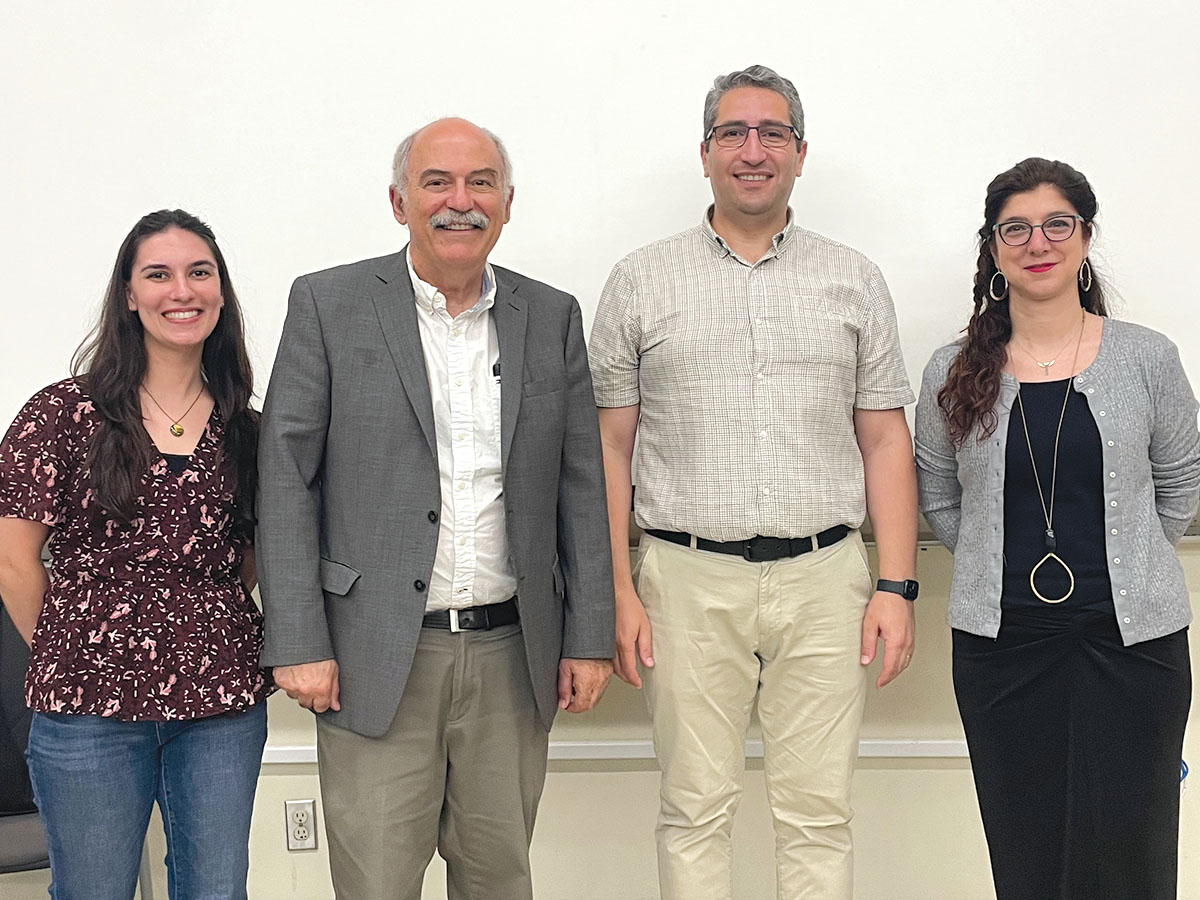
Left to right: Sosse Baloian Yanez, Prof. Barlow Der Mugrdechian, Dr. David Zakarian, and Dr. Talin Suciyan.
Rachel Yepremian-Owens
Staff Writer
On Friday, May 9, 2025, Dr. David Zakarian, Haig and Isabel Berberian Professor of Armenian Studies at Fresno State, gave a lecture titled “Glimpses into Women’s Lives in Medieval Armenia.” The purpose of the lecture was to explore how Armenian historical sources offer rare, yet valuable insights into the experiences of women in the Middle Ages.
The lecture was part of the Armenian Studies Program Spring Lecture Series and was held on the Fresno State campus.
Dr. Zakarian’s research is centered around the role of women in Armenian historiography. He focuses on the role of women as recorded in Armenian manuscripts and shows the underrepresentation of women, since around 95% of the Armenian manuscript writers were men.
Dr. Zakarian opened his lecture with a question: “Who were some of the historical figures you learned about when you were in school?” This is one of the various struggles we as a society face, the lack of representation of women in historical sources, and this problem points back to the ubiquitous patriarchy.
Women’s voices were purposefully excluded from the conversation.
“We need to put this in our school curriculum,” Dr. Zakarian said. “We need to present these figures and try to instill in women these ideas about how they are a part of this community and they can’t be silenced. Their voices should be heard.”
Dr. Zakarian pointed out that his main source of research is looking at the historical colophons. Colophons are memorial messages written by the scribe, typically added to the end of the manuscripts.
Providing more details about the manuscript itself, the colophon shows who sponsored the manuscript and paid for it to be produced, as well as stories of the production process of the manuscript that the scribe experienced. Often, these stories mention women and/or are written by women.
The Gospel of Sassoon was the first manuscript Dr. Zakarian spoke about and he mentioned that the colophon at the end of the manuscript was dedicated to a woman named Kata, hoping that the readers will pray for her and God will deem her as one of the wise, holy virgins.
The description of the colophon addresses Kata’s mother, Melekset, and her royal lineage calling her taguhi or “queen,” her role as being a decorator of churches, protector of priests, guardian of the holy and the widows, dressing the naked and feeding the hungry and eventually reaching the point of Kata’s birth. Kata was beautiful and greatly respected, yet passed early on while giving birth to twins. Her mother sponsored the manuscript in honor and memory of her daughter.
Dr. Zakarian then moved on to speaking about Gandzasar, a beautiful Armenian monastery in Artsakh that is now under Azerbaijani control.
Inside the monastery is a wonderful vestibule, also called a gawit. The writing says that the gawit was built by Mamkan, the Lord of Artsakh’s wife, meaning that it was built with her money and her money alone. However, this was not the only building Mamakan sponsored.
There is a chapel in Artsakh called Surb Stepanos, specifically in a village called Vajar. There is another inscription mentioning Mamkan, which, interestingly, was written in the first person stating that she had built churches and donated her own land in Alnchay as a gift. She had her own money, property and assets and could do whatever she pleased with it. Mamkan also contributed to the renovation of the Kecharis Monastery in Kotayk province of Armenia. Mamkan played a vital role in Armenian history, being recognized as “the comfort and consolation of all soldiers and cavalry, as well as the church and clergy.”
Other influential women mentioned in the talk were Jahan-Melik who paid for the manuscript with her own money following the process of being a treasured bride, Xalim-Xatum who suffered and preserved through the death of her three young sons and her husband, Zapel who was a 13th-century woman who worked in manuscript copying and another woman, Alits, who was also a well-versed scribe whose writing was so valuable, she would only marry the man who could copy her style of writing to almost perfection.
These stories are just a few out of many about influential women of Armenian history, not often talked about and more so not known at all. “Through sustained research and a commitment to challenging patriarchal silences, the women who played pivotal roles in ancient history can be restored to visibility and acknowledged for their contributions,” stated Dr. Zakarian. “Recognizing their agency not only affirms their rightful place in the historical record but also provides empowering connections and models for women today.”
“It is my personal belief that every woman deserves this, every person, but especially women because they were constantly erased from these narratives,” concluded Dr. Zakarian. “They deserve to be represented on the pages of books so that we talk about them…I think these stories should be told.”