 Hye Sharzhoom Armenian Action
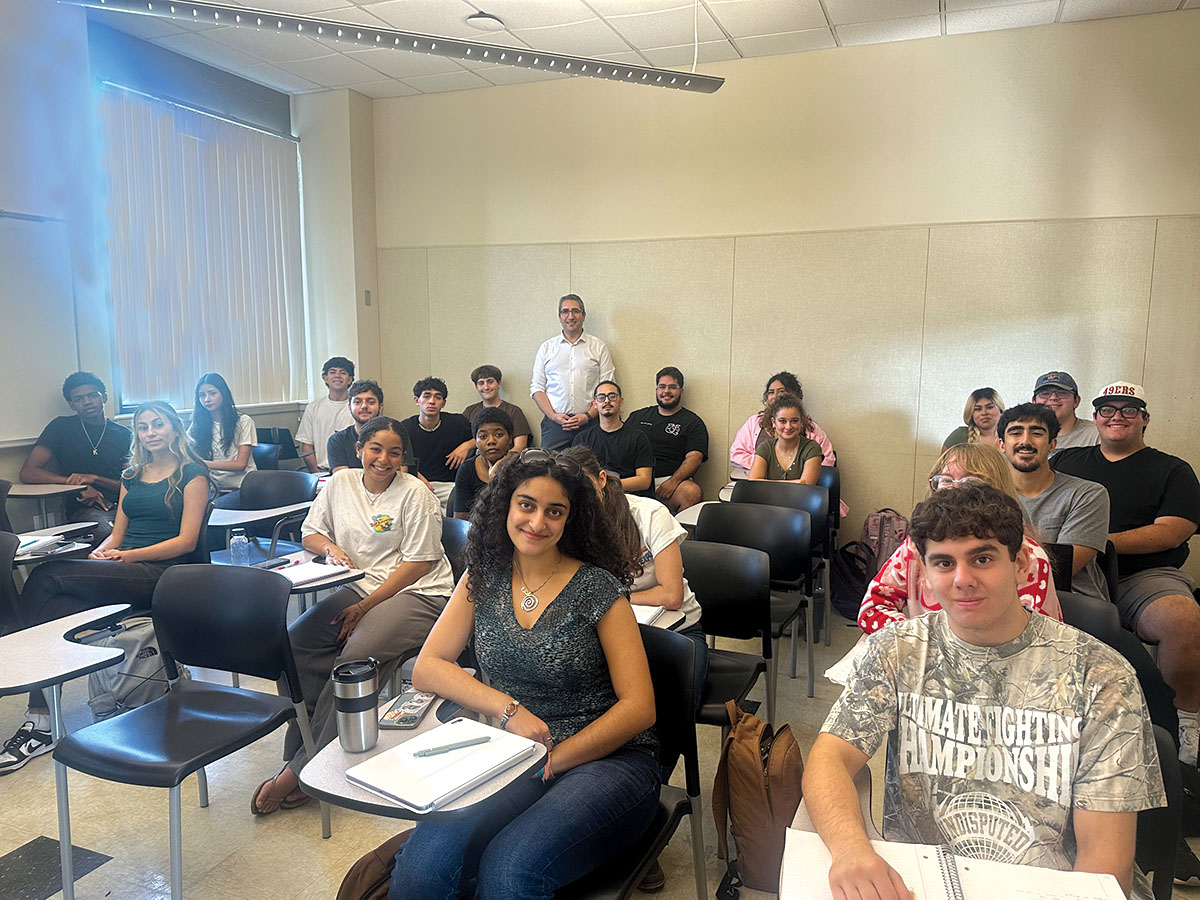
Dr. David Zakarian, standing center, with elementary Armenian language students.
Nellie Chobanyan
Staff Writer
At Fresno State, the Armenian 1A-Elementary Armenian course continues to draw students from a variety of majors and backgrounds, united by a shared goal: learning the Armenian language and connecting more deeply with its culture.
For many, the class is more than just fulfilling a requirement, it’s about identity and belonging. “I’m taking this course to learn how to speak Armenian and get in touch with my roots,” shared junior Emma Wyatt. Others echoed this sense of connection to heritage and community. Junior Jayden Atachian explained, “I am half Armenian, so I thought I should learn the language. I want to be able to understand and speak with family and friends.”
Freshman Lara Habib described both excitement and progress in her first semester of the course. “I want to become fluent in Armenian,” she said. “I love it! It’s very interactive, and I’ve learned so much already. I hope to make more Armenian friends and speak Armenian fluently.” Junior Sylvie Khatchikian shared a similar passion for strengthening her language skills. Pursuing a minor in Armenian Studies, she said she chose the class because Armenian is her mother tongue and she wants to deepen her connection to her culture. “I want to become better at reading and writing,” she added, testifying that she “loves it.”
Junior Laurel Machoian also enrolled with the goal of building greater fluency. “I want to learn more Armenian fluency since I’m Armenian, and I expect to learn the basics of the Armenian language and grammar,” she said. Reflecting on her experience so far, she added, “I really enjoy the material and the teaching methods. It’s clear that I will get out of this class what I put into it.”
Freshman Vanessa Ventura offered a different perspective. While not Armenia herself, she said she wanted to expand her language skills. “I want to learn Armenian because I work around many Armenians, and I want to learn it as a third language,” Ventura explained.
Dr. David Zakarian, who teaches the course, emphasized that teaching Armenian 1A requires a unique approach. “Language teaching is a different set of skills… it’s less lecturing and more interacting,” he explained. He noted that the diversity of students, some knowing nothing of Armenian and others more fluent, presents a challenge. “Students come into the class with different levels of proficiency, some know conversational Armenian, which is influenced by different countries’ dialects, and some know absolutely nothing about the language, so bringing everyone to the same level is difficult, but we start from scratch and by slowly teaching the letters and alphabet we are able to carry into conversations,” he said.
To make learning accessible, Dr. Zakarian uses transliteration, videos, and online resources. He hopes to create a new Western Armenian textbook in the future to better align with teaching standards. “It hasn’t started yet, but the idea is there to create a better and more accessible textbook,” he shared.
Reflecting on student growth, he recalled a past student who arrived knowing nothing of Armenian but became one of the most fluent speakers in the class. “Even fluent Armenians were surprised by his pronunciation,” Dr. Zakarian said.
On the broader significance of the program, he stressed the importance of preserving Armenian at Fresno State. “We have such a big, strong community here… the Program wouldn’t be as strong and influential as it is without that community,” he noted, citing the contribution of Armenian scholars since 1974 and the excellent library resources available to students.
By the end of the course, Dr. Zakarian sees students either mastering language skills as part of a requirement or using the language to strengthen personal connections. “I encourage them to use it with their family and friends… it expands your brain and builds new connections,” he said. He emphasized that learning Armenian also equips students with broader skills for language acquisition and cultural understanding.
Dr. Zakarian highlighted the Armenian Genocide Monument on campus, noting, “I like to encourage my students by showing them the Armenian Genocide Monument here at Fresno State. Unlike most students, those who complete this class will be able to read the Armenian inscriptions on the monument, setting themselves apart.”
Looking ahead, Dr. Zakarian hopes to create interactive, digital resources that make Armenian fun and practical for the 21st century. “I want the classes to be fun and interactive… not a chore for students,” he said. “Even if you don’t use it later, you learn how to learn, and the more languages you know, the more human you are.”
As these students’ experiences show, Armenian 1A is more than just an academic class; it’s a pathway to fluency, cultural understanding, and stronger ties to community.