 Hye Sharzhoom Armenian Action
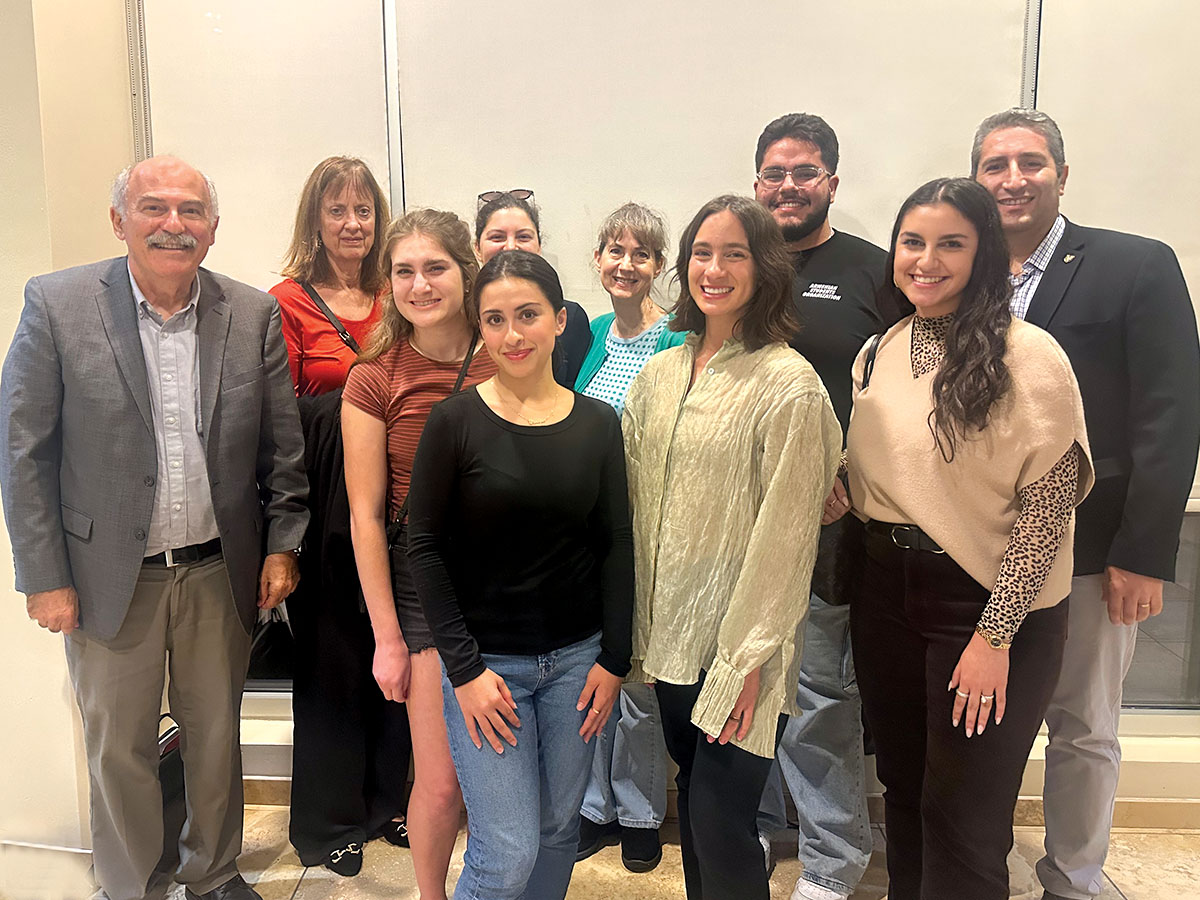
Director Emily Mkrtichian, fourth from right, and students and faculty at the screening of Mkrtichian’s film.
Rachel Yepremian-Owens
Staff Writer
On Friday, September 19, in honor of the 2-year anniversary of the Artsakh war, the Media, Communications and Journalism CineCulture course collaborated with the Armenian Studies Program to screen Emily Mkrtichian’s film, “There Was, There Was Not.”
CineCulture Prof. Mary Husain and Prof. Barlow Der Mugrdechian of the Armenian Studies Program introduced the film and the director, Emily Mkrtichian. Prof. Husain and Prof. Der Mugrdechian have been working together for more than seventeen years to screen Armenian themed movies as part of the CineCulture series.
“There Was, There Was Not” not only highlighted the very different, but beautifully connected lives of four influential women in Artsakh, but also showed what life was, what it is like now, and what it could be in Artsakh.
Mkrtichian’s film process began with a different intent than what was eventually screened. She originally intended to create a film that documented and celebrated women in Artsakh as unique forces in their community. She was even working with an artist to create life sized portraits of these women and had a goal of bringing her film to a close in 2020.
The Artsakh war broke out in September 2020, and everything changed. Mkrtichian found herself adjusting the trajectory of the film, still partially accomplishing what she originally desired, but there was now an additional element to the story.
Mkrtichian’s movie put life in Artsakh into perspective for an audience of both Armenians and non-Armenians. Sose, Gayane, Svetlana, and Siranush were all citizens of Artsakh and lived such different lives, yet agreed in their hearts on one thing – Artsakh was home.
Sose Balasanyan was a world-class martial artist in Judo, full of pure joy and optimism for the future. She sacrificed herself for her land and her people and joined the Artsakh army as a front-line soldier. She had dreams of going to the Olympics one day; she stopped dreaming when war became her reality.
Gayane Hambardzumyan devoted her life to serving people, fighting for rights and helping women. She left behind the one and only Women Resource Center she established in Artsakh and fled to Armenia to continue her work, aiding the displaced refugees of her own homeland.
Svetlana Harutunyan was one of the first and only women to work as a deminer, in war areas; a truly dangerous job, but she only cared to help her land recover. She was able to reunite with her daughters, who were living in Armenia, before the blockade of travel from Artsakh to Armenia was implemented.
Siranush Sargsyan was a political activist, campaigning for a spot on the local city council and advocating for women’s rights. She is now working as a very successful journalist who continues her efforts in making Artsakh a place that Armenians and non-Armenians will never forget. Through the tears and the sorrows, they could only hold onto their precious home for so long.
After watching the movie, the audience had the opportunity to have an open discussion with the director to gain more understanding behind her purpose and thought process of the film.
Mkrtichian stated that Artsakh was a very dangerous place during her time of filming. She had no training in conflict journalism and often found herself questioning whether she should or shouldn’t be in certain areas and if it was worth the risk to capture for the film, including going to the front lines of battle.
“During that time, I asked Sose to film herself on her camera and ultimately Sose told me many, many times that she didn’t want me there because of the amount of danger,” Mkrtichian said. “She would describe bullets and shrapnel breezing just by her face and seeing a lot of very scary things. I trusted her basically.”
Her experience with conflict journalism showed that journalists from all over the world are very swift to travel to a conflict zone and to share the stories with the rest of the world. Having spent four years in Artsakh, Mkrtichian struggled to understand how these fellow journalists that spent a few days in the region could possibly be providing the world with the full story. This is because their primary focus was on the same thing everyone else was focusing on. The battle, the weapons, the bombs, and while these are all very important, their perception was limited.
“Whenever a bomb was dropped, everyone would run toward the explosion, everyone would run there,” said Mkrtichian. “I kind of made a decision for myself that there were people documenting that. I would always run towards one of the women and their experience and their emotional journey in that moment as something that no one else seemed to be pointing a camera at.”
Mkrtichian’s film impacted many of the audience members. The audience asked questions, made comments and reflections that they shared throughout the after-film discussion. With the immense amount of tragedy and division occurring in the world currently, audience members expressed their thankfulness to Mkrtichian. They expressed their gratitude for her efforts over long, tedious years putting together a film that has the ability to impact a generation.
Mkrtichian’s films have been screened in various world-wide film festivals and are continuing to be shown. She mentioned that all four of the women have seen “There Was, There Was Not,” and when it was screened in Armenia, with them in the audience, it was an emotional experience.
The never-failing goal of a film like this is to keep Artsakh’s history alive and the beauty of these lives that were once lived there, honored.
“I show photos of Gayane’s family, those kind of black and white archival photos,” Mkrtichian said. “She doesn’t have those photos, those were all left behind. There’s some way in which this film keeps alive something that they miss.”